A strong essay is not just well organized. It is also written with the right words. When you can reach for the precise term instead of an approximate one, your arguments get sharper, your sentences get shorter, and your reader trusts you more. Graders notice it, even when they do not name it. So if you want your writing to improve, growing your vocabulary is one of the most reliable places to invest your effort.
The good news is that this is a skill, not a talent. You do not need to be a natural reader or a native speaker to build a large, usable vocabulary. You need a method and a little consistency. This guide explains one that works.
Why word lists usually fail
The first instinct most students have is to memorize a list. A "100 words to impress your professor" list, a word a day app, a stack of flashcards copied from a test prep book. These rarely stick, and the reason is simple. Words learned out of context are easy to forget and hard to use. You might recall that "ubiquitous" means common, but you will not know how it actually behaves in a sentence, what it pairs with, or when it sounds natural rather than forced. So the word sits in passive memory and never makes it into your writing.
There is a second problem with lists. They are generic. The words you genuinely need are the ones that show up in the texts you read for your own courses and interests, and no one else's list can predict those.
Learn words from what you already read
The vocabulary that ends up in your essays comes from the vocabulary you meet in your reading. Every article, chapter, and case study you work through for class is full of words that are slightly beyond your active range. Those are the words worth learning, because you have already seen them used correctly, in a real context, by a writer in your field. That context is what makes a word memorable and usable.
So the core method is this. Read the material you would read anyway, but stop treating unfamiliar words as noise to skim past. Treat them as your personal word list, one that is automatically relevant because it comes from your own reading.
A method you can actually keep up
Here is a routine that turns reading into vocabulary growth without much extra work.
1. Capture the words you do not know. As you read, mark every word you could not confidently define or use yourself. Do not stop to look each one up, that breaks your reading. Just collect them.
2. Keep the sentence, not just the word. When you do look a word up, save the sentence you found it in. The surrounding context is half the meaning. It shows you the register, the typical companions of the word, and the situations it fits.
3. Review on a schedule, not all at once. Memory fades on a predictable curve, and the fix is spaced repetition: review a word a day later, then a few days later, then a week later. Spacing the reviews out is what moves a word from "I have seen this" to "I can use this." Cramming does the opposite.
4. Use each new word in writing, soon. A word is not yours until you have produced it, not just recognized it. Work a handful of your new words into your next essay or even a single practice paragraph. The first time you use a word in your own sentence is the moment it sticks.
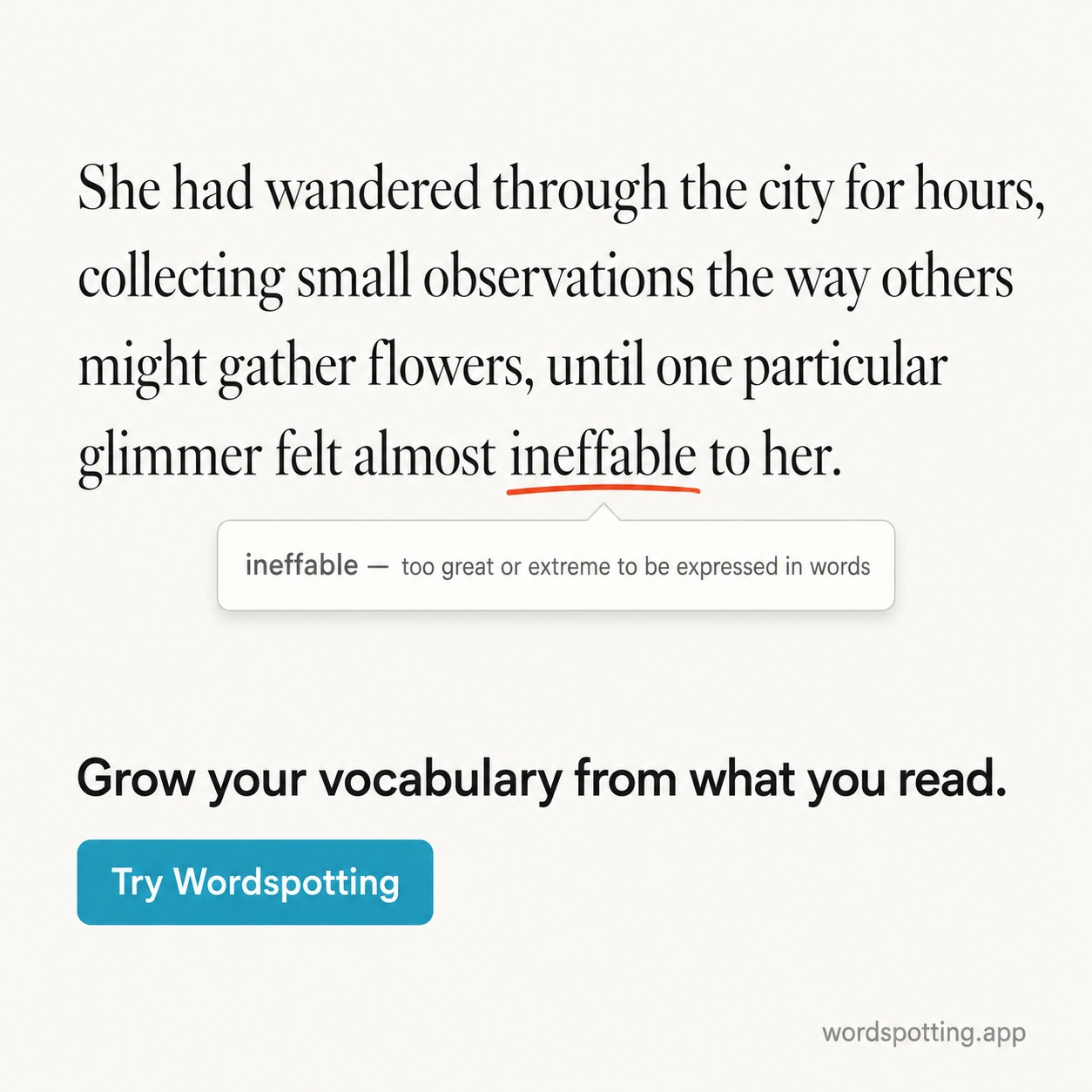
Doing all of this by hand, with notebooks and flashcards, is possible but tedious, which is why most people quit. This is also exactly the kind of work software is good at. A tool like Wordspotting follows this method for you: you paste in the articles, book passages, or transcripts you are already reading, it compares them against the words you already know, and it surfaces the unfamiliar ones with the real sentence they appeared in. The words you choose to learn become spaced repetition cards, so the review schedule is handled automatically. The point is not the app itself, it is that the method behind it, learning real words from your own reading and reviewing them over time, is the part that works.
Aim for precision, not decoration
One warning. A bigger vocabulary is a tool for being clearer, not for sounding clever. The classic mistake is to open a thesaurus and swap plain words for longer ones, hoping the essay will seem more sophisticated. It almost always reads worse, because the substitutes carry slightly different meanings and the seams show. Reach for a less common word only when it says something the common word cannot. Used that way, a strong vocabulary makes your writing simpler and more exact, which is the whole point.
Build your vocabulary from your own reading, in context, with a little spacing over time, and put the new words to work. Do that steadily through a semester and the difference in your essays will be obvious. If you want a structured way to do it, Wordspotting was built for exactly this.